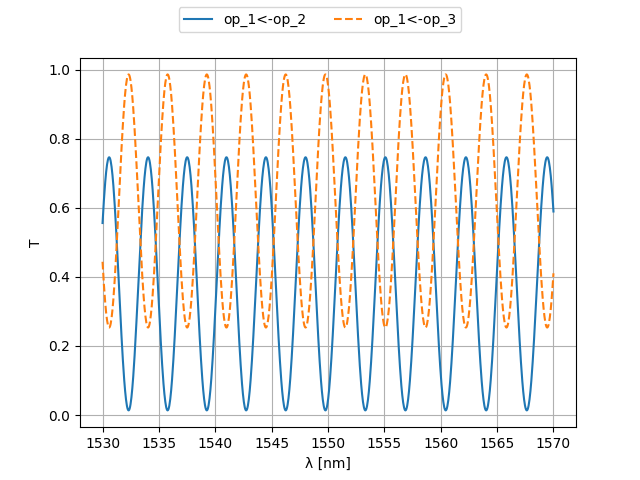
MZI post-simulation
Full script
from typing import Any, Sequence, Tuple

import matplotlib.pyplot as plt
import numpy as np

from fnpcell import all as fp
from fnpcell.interfaces import IScatterMatrix
from gpdk import all as pdk


class DCModel(fp.sim.SimModel):
    op_0: fp.IOwnedPort
    op_1: fp.IOwnedPort
    op_2: fp.IOwnedPort
    op_3: fp.IOwnedPort
    coupling: float = 0.5

    def simulate_scatter(self, wavelengths: Sequence[float]) -> IScatterMatrix:
        coupling = np.array(self.coupling)
        kappa = coupling**0.5
        tau = (1 - coupling) ** 0.5

        op_0, op_1, op_2, op_3 = self.op_0, self.op_1, self.op_2, self.op_3

        S = fp.sim.SMatrix()

        S[op_2, op_1] = S[op_1, op_2] = tau, 0
        S[op_3, op_1] = S[op_1, op_3] = kappa, np.pi / 2
        S[op_2, op_0] = S[op_0, op_2] = kappa, np.pi / 2
        S[op_3, op_0] = S[op_0, op_3] = tau, 0

        return S


class WGModel(fp.sim.SimModel):
    op_0: fp.IOwnedPort
    op_1: fp.IOwnedPort
    wl0: float = 1.55
    neff: float = 2.34
    ng: float = 3.4
    loss: float = 0.0

    def simulate_scatter(self, wavelengths: Sequence[float]) -> IScatterMatrix:
        wl = np.array(wavelengths)
        wl0 = np.array(self.wl0)
        neff = np.array(self.neff)
        ng = np.array(self.ng)
        loss = np.array(self.loss)
        length = fp.distance_between(self.op_0.position, self.op_1.position)

        dwl = wl - self.wl0
        dneff_dwl = (ng - neff) / wl0
        neff = neff - dwl * dneff_dwl

        mag = 10 ** (-loss * length / 20)
        arg = 2 * np.pi * neff * length / wl

        op_0 = self.op_0
        op_1 = self.op_1

        S = fp.sim.SMatrix()

        S[op_1, op_0] = S[op_0, op_1] = mag, arg

        return S


class DC(fp.PCell):
    def build(self):
        insts, elems, ports = super().build()

        dc = pdk.DirectionalCouplerSBend()
        insts += dc, "dc"
        ports += dc.ports

        return insts, elems, ports

    def sim_model(self, coupling: float = 0.5):
        op_0, op_1, op_2, op_3 = self[fp.IOwnedPort, "op_0", "op_1", "op_2", "op_3"]
        return DCModel(op_0=op_0, op_1=op_1, op_2=op_2, op_3=op_3, coupling=coupling)


class Straight(fp.PCell):
    length: float = fp.PositiveFloatParam(default=200)

    def build(self):
        insts, elems, ports = super().build()

        s = pdk.Straight(length=self.length)
        insts += s, "s"
        ports += s.ports

        return insts, elems, ports

    def sim_model(self, wl0: float = 1.55, neff: float = 2.34, ng: float = 3.4, loss: float = 0.0):
        op_0, op_1 = self[fp.IOwnedPort, "op_0", "op_1"]
        return WGModel(op_0=op_0, op_1=op_1, wl0=wl0, neff=neff, ng=ng, loss=loss)


class Mzi(fp.PCell):
    def build(self):
        insts, elems, ports = super().build()

        dc = DC()
        top_arm = Straight()
        insts += top_arm, "top_arm"

        left_dc = fp.place(dc, "op_3", at=top_arm["op_0"])
        insts += left_dc, "left_dc"

        right_dc = fp.place(dc, "op_0", at=top_arm["op_1"])
        insts += right_dc, "right_dc"

        ports += left_dc["op_0"]
        ports += left_dc["op_1"]
        ports += right_dc["op_2"]
        ports += right_dc["op_3"]

        return insts, elems, ports

    def simpre_netlist(self):
        optical_netlist, electrical_netlist = self.interconnect()

        left_dc = self.get("left_dc", DC)
        right_dc = self.get("right_dc", DC)

        optical_netlist += left_dc[fp.IOwnedPort, "op_2"] >> right_dc[fp.IOwnedPort, "op_1"]

        return optical_netlist, electrical_netlist

    def sim_model(self, left_coupling: float = 0.5, right_coupling: float = 0.5):
        left_dc = self.get("left_dc", DC)
        right_dc = self.get("right_dc", DC)
        models = {
            left_dc: left_dc.sim_model(coupling=left_coupling),
            right_dc: right_dc.sim_model(coupling=right_coupling),
        }
        return fp.sim.CircuitModel(self, self.simpre_netlist(), models)


class MziArray(fp.PCell):
    def build(self):
        insts, elems, ports = super().build()

        mzi = Mzi()
        mzi_array = mzi.new_array(cols=2, col_width=100)
        insts += mzi_array, "mzi_array"

        mzi_0 = mzi_array.get(col=0)
        mzi_1 = mzi_array.get(col=1)
        ports += mzi_0["op_0"]
        ports += mzi_0["op_1"]
        ports += mzi_1["op_2"]
        ports += mzi_1["op_3"]

        return insts, elems, ports

    def simpre_netlist(self):
        optical_netlist, electrical_netlist = self.interconnect()

        mzi_array = self.get("mzi_array", fp.IArrayRepetition[Mzi])
        mzi_0 = mzi_array.get(col=0)
        mzi_1 = mzi_array.get(col=1)

        optical_netlist += mzi_0[fp.IOwnedPort, "op_2"] >> mzi_1[fp.IOwnedPort, "op_1"]
        optical_netlist += mzi_0[fp.IOwnedPort, "op_3"] >> mzi_1[fp.IOwnedPort, "op_0"]

        return optical_netlist, electrical_netlist

    def sim_model(self, left_coupling: float = 0.5, right_coupling: float = 0.5):
        mzi_array = self.get("mzi_array", fp.IArrayRepetition[Mzi])
        models = {inst: inst.sim_model(left_coupling, right_coupling) for inst in mzi_array.decompose()}
        return fp.sim.CircuitModel(self, self.simpre_netlist(), models)


if __name__ == "__main__":
    from gpdk.util.path import local_output_file

    gds_file = local_output_file(__file__).with_suffix(".gds")
    library = fp.Library()
    # ===========================

    # layout
    mzi_array = MziArray()
    # wg = Straight()
    # mzi = Mzi()

    library += mzi_array
    fp.export_gds(library, file=gds_file)
    fp.plot(library)

    # simulation
    model = mzi_array.sim_model(left_coupling=0.3, right_coupling=0.8)
    # model = wg.sim_model()

    wl = np.linspace(1.53, 1.57, 1000)  # type: ignore
    smatrix = model.simulate_scatter(wl)  # type: ignore

    # plot
    def p2r(value: Tuple[Any, Any]):
        mag = value[0]
        ang = value[1]
        return mag * np.exp(1j * ang)

    op_1, op_2, op_3 = mzi_array[fp.IOwnedPort, "op_1", "op_2", "op_3"]
    # op_1, op_2 = wg[fp.IOwnedPort, "op_0", "op_1"]
    plt.plot(1e3 * wl, np.abs(p2r(smatrix[op_1, op_2])) ** 2, label="op_1<-op_2")  # type: ignore
    plt.plot(1e3 * wl, np.abs(p2r(smatrix[op_1, op_3])) ** 2, label="op_1<-op_3", ls="--")  # type: ignore
    plt.xlabel("λ [nm]")  # type: ignore
    plt.ylabel("T")  # type: ignore
    plt.grid(True)  # type: ignore
    plt.figlegend(ncol=2, loc="upper center")  # type: ignore
    plt.show()  # type: ignore
Build simulation models for WG, DC
The below scripts shows how to build a simulation model which will be then implemented in waveguide and directional coupler.
Directional Coupler simulation model:
class DCModel(fp.sim.SimModel):
    op_0: fp.IOwnedPort
    op_1: fp.IOwnedPort
    op_2: fp.IOwnedPort
    op_3: fp.IOwnedPort
    coupling: float = 0.5

    def simulate_scatter(self, wavelengths: Sequence[float]) -> IScatterMatrix:
        coupling = np.array(self.coupling)
        kappa = coupling**0.5
        tau = (1 - coupling) ** 0.5

        op_0, op_1, op_2, op_3 = self.op_0, self.op_1, self.op_2, self.op_3

        S = fp.sim.SMatrix()

        S[op_2, op_1] = S[op_1, op_2] = tau, 0
        S[op_3, op_1] = S[op_1, op_3] = kappa, np.pi / 2
        S[op_2, op_0] = S[op_0, op_2] = kappa, np.pi / 2
        S[op_3, op_0] = S[op_0, op_3] = tau, 0

        return S
Waveguide simulation model:
class WGModel(fp.sim.SimModel):
    op_0: fp.IOwnedPort
    op_1: fp.IOwnedPort
    wl0: float = 1.55
    neff: float = 2.34
    ng: float = 3.4
    loss: float = 0.0

    def simulate_scatter(self, wavelengths: Sequence[float]) -> IScatterMatrix:
        wl = np.array(wavelengths)
        wl0 = np.array(self.wl0)
        neff = np.array(self.neff)
        ng = np.array(self.ng)
        loss = np.array(self.loss)
        length = fp.distance_between(self.op_0.position, self.op_1.position)

        dwl = wl - self.wl0
        dneff_dwl = (ng - neff) / wl0
        neff = neff - dwl * dneff_dwl

        mag = 10 ** (-loss * length / 20)
        arg = 2 * np.pi * neff * length / wl

        op_0 = self.op_0
        op_1 = self.op_1

        S = fp.sim.SMatrix()

        S[op_1, op_0] = S[op_0, op_1] = mag, arg

        return S
Implement simulation models to components
After building up the simulation models, we have to implement them to the components. The sim_model function of the component will be defined under the cell class.
Take waveguide as an example, the port names which we defined in the build method op_0, op_1 have to be implemented in the sim_model self[fp.IOwnedPort, "op_0", "op_1"].
Directional Coupler:
class DC(fp.PCell):
   def build(self):
       insts, elems, ports = super().build()

       dc = pdk.DirectionalCouplerSBend()
       insts += dc, "dc"
       ports += dc.ports

       return insts, elems, ports

   def sim_model(self, coupling: float = 0.5):
       op_0, op_1, op_2, op_3 = self[fp.IOwnedPort, "op_0", "op_1", "op_2", "op_3"]
       return DCModel(op_0=op_0, op_1=op_1, op_2=op_2, op_3=op_3, coupling=coupling)
Waveguide:
class Straight(fp.PCell):
    length: float = fp.PositiveFloatParam(default=200)

    def build(self):
        insts, elems, ports = super().build()

        s = pdk.Straight(length=self.length)
        insts += s, "s"
        ports += s.ports

        return insts, elems, ports

    def sim_model(self, wl0: float = 1.55, neff: float = 2.34, ng: float = 3.4, loss: float = 0.0):
        op_0, op_1 = self[fp.IOwnedPort, "op_0", "op_1"]
        return WGModel(op_0=op_0, op_1=op_1, wl0=wl0, neff=neff, ng=ng, loss=loss)
Build MZI circuit and define poet-simulation functions
Build function to build MZI circuit. Note that those ports which are not connected to other ports should be added to
ports+=, otherwise there will be error when generating netlist.class Mzi(fp.PCell): def build(self): insts, elems, ports = super().build() dc = DC() top_arm = Straight() insts += top_arm, "top_arm" left_dc = fp.place(dc, "op_3", at=top_arm["op_0"]) insts += left_dc, "left_dc" right_dc = fp.place(dc, "op_0", at=top_arm["op_1"]) insts += right_dc, "right_dc" ports += left_dc["op_0"] ports += left_dc["op_1"] ports += right_dc["op_2"] ports += right_dc["op_3"] return insts, elems, ports
Generate netlist for pre-simulation. Ports connections without physically connected should be added here. For example,
op_2ofleft_dcandop_1ofright_dcis not linked to each other in the build method yet. However, we can virtually connect them together in thesimpre_netlistmethod to run the post-simulation.def simpre_netlist(self): optical_netlist, electrical_netlist = self.interconnect() left_dc = self.get("left_dc", DC) right_dc = self.get("right_dc", DC) optical_netlist += left_dc[fp.IOwnedPort, "op_2"] >> right_dc[fp.IOwnedPort, "op_1"] return optical_netlist, electrical_netlist
Define simulation model for the MZI circuit. In this example, we are only setting the simulation parameters of
left_dcandright_dcto be controllable. Thus, in this case, the other components in this circuit will remain to the simulation model we implemented in the cell class.def sim_model(self, left_coupling: float = 0.5, right_coupling: float = 0.5): left_dc = self.get("left_dc", DC) right_dc = self.get("right_dc", DC) models = { left_dc: left_dc.sim_model(coupling=left_coupling), right_dc: right_dc.sim_model(coupling=right_coupling), } return fp.sim.CircuitModel(self, self.simpre_netlist(), models)
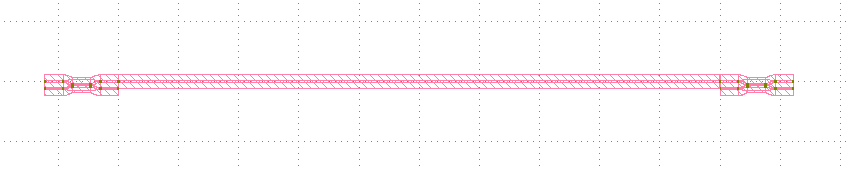
Generate GDS file and run post-simulation
Generate GDS file.
if __name__ == "__main__":
    from gpdk.util.path import local_output_file

    gds_file = local_output_file(__file__).with_suffix(".gds")
    library = fp.Library()
    # ===========================

    # layout
    mzi= Mzi()

    library += mzi
    fp.export_gds(library, file=gds_file)
    fp.plot(library)
Run post-simulation of the circuit.
Set circuit simulation model. Here the parameters
left_couplingandright_couplingwill assign to the coupling parameters of the DC simulation model.
model = mzi_array.sim_model(left_coupling=0.3, right_coupling=0.8)
Calculate circuit S-Matrix.
wl = np.linspace(1.53, 1.57, 1000)  # type: ignore
smatrix = model.simulate_scatter(wl)  # type: ignore
Plot the simulation results. We first convert magnitude and argument to a complex data.
def p2r(value: Tuple[Any, Any]):
    mag = value[0]
    ang = value[1]
    return mag * np.exp(1j * ang)

op_1, op_2, op_3 = mzi_array[fp.IOwnedPort, "op_1", "op_2", "op_3"]
plt.plot(1e3 * wl, np.abs(p2r(smatrix[op_1, op_2])) ** 2, label="op_1<-op_2")  # type: ignore
plt.plot(1e3 * wl, np.abs(p2r(smatrix[op_1, op_3])) ** 2, label="op_1<-op_3", ls="--")  # type: ignore
plt.xlabel("λ [nm]")  # type: ignore
plt.ylabel("T")  # type: ignore
plt.grid(True)  # type: ignore
plt.figlegend(ncol=2, loc="upper center")  # type: ignore
plt.show()  # type: ignore