Demultiplexer
Full script
from fnpcell import all as fp
from gpdk import all as pdk
from gpdk.technology import get_technology


class Demultiplexer2(fp.PCell):
    def build(self):
        insts, elems, ports = super().build()
        # fmt: off
        TECH = get_technology()

        ec = pdk.Fixed_Edge_Coupler(name="e")
        dc31 = pdk.DirectionalCouplerBend(
            coupler_spacing=1.5,
            coupler_length=31,
            bend_radius=25,
            waveguide_type=TECH.WG.MWG.C.WIRE,
        )
        dc18 = pdk.DirectionalCouplerBend(
            coupler_spacing=1.5,
            coupler_length=18,
            bend_radius=25,
            waveguide_type=TECH.WG.MWG.C.WIRE,
        )
        dc3 = pdk.DirectionalCouplerBend(
            coupler_spacing=1.5,
            coupler_length=3,
            bend_radius=25,
            waveguide_type=TECH.WG.MWG.C.WIRE,
        )
        tm = pdk.Fixed_Terminator_TE_1550(
            length=30,
            waveguide_type=TECH.WG.MWG.C.WIRE,
            transform=fp.rotate(degrees=180),
        )
        pd = pdk.Fixed_Photo_Detector(name="p")

        ec_0 = ec.translated(-100, 150)
        ec_1 = ec.translated(-100, -150)

        dc_0 = dc31.translated(200, 0)
        dc_1 = dc18.translated(400, 0)
        dc_2 = dc3.translated(600, 0)
        dc_3_0 = dc31.translated(dc_2["op_3"].position[0] - dc31["op_0"].position[0], 180)
        dc_3_1 = dc31.translated(dc_2["op_2"].position[0] - dc31["op_1"].position[0], -180)

        t_0 = tm.translated(500, 280)
        t_1 = tm.translated(500, -280)

        dc_4_0 = dc3.translated(820, 180)
        dc_4_1 = dc3.translated(820, -180)

        pd_0 = pd.translated(970, 300)
        pd_1 = pd.translated(970, 60)
        pd_2 = pd.translated(970, -60)
        pd_3 = pd.translated(970, -300)

        links = fp.create_links(
            link_type=TECH.WG.SWG.C.WIRE,
            bend_factory=TECH.WG.SWG.C.WIRE.BEND_EULER,
            specs=[
                ec_0["op_0"] >> dc_0["op_0"],
                ec_1["op_0"] >> dc_0["op_1"],
                #
                (dc_0["op_3"] >> dc_1["op_0"], 500),
                dc_0["op_2"] >> dc_1["op_1"],
                dc_1["op_3"] >> dc_2["op_0"],
                (dc_1["op_2"] >> dc_2["op_1"], 500),
                #
                dc_2["op_3"] >> dc_3_0["op_1"],
                dc_2["op_2"] >> dc_3_1["op_0"],
                t_0["op_0"] >> dc_3_0["op_0"],
                t_1["op_0"] >> dc_3_1["op_1"],
                #
                (dc_3_0["op_3"] >> dc_4_0["op_0"], 300),
                dc_3_0["op_2"] >> dc_4_0["op_1"],
                dc_3_1["op_3"] >> dc_4_1["op_0"],
                (dc_3_1["op_2"] >> dc_4_1["op_1"], 300),
                #
                dc_4_0["op_3"] >> pd_0["op_0"],
                dc_4_0["op_2"] >> pd_1["op_0"],
                dc_4_1["op_3"] >> pd_2["op_0"],
                dc_4_1["op_2"] >> pd_3["op_0"],
            ],
        )

        insts += ec_0, 'ec_0'
        insts += ec_1, 'ec_1'
        insts += dc_0, 'dc_0'
        insts += dc_1, 'dc_1'
        insts += dc_2, 'dc_2'
        insts += dc_3_0, 'dc_3_0'
        insts += dc_3_1, 'dc_3_1'
        insts += t_0, 't_0'
        insts += t_1, 't_1'
        insts += dc_4_0, 'dc_4_0'
        insts += dc_4_1, 'dc_4_1'
        insts += pd_0, 'pd_0'
        insts += pd_1, 'pd_1'
        insts += pd_2, 'pd_2'
        insts += pd_3, 'pd_3'
        insts += links

        # fmt: on
        return insts, elems, ports


if __name__ == "__main__":
    from gpdk.components import all as components
    from gpdk.util.path import local_output_file

    gds_file = local_output_file(__file__).with_suffix(".gds")
    library = fp.Library()

    TECH = get_technology()
    naming_table = {}
    # =============================================================
    # fmt: off

    device = Demultiplexer2()
    library += device

    # fmt: on
    # =============================================================
    fp.export_gds(library, file=gds_file, cell_naming_table=naming_table)
    # fp.plot(library)
View GDS layout file
Use Klayout to open the generated original layout.
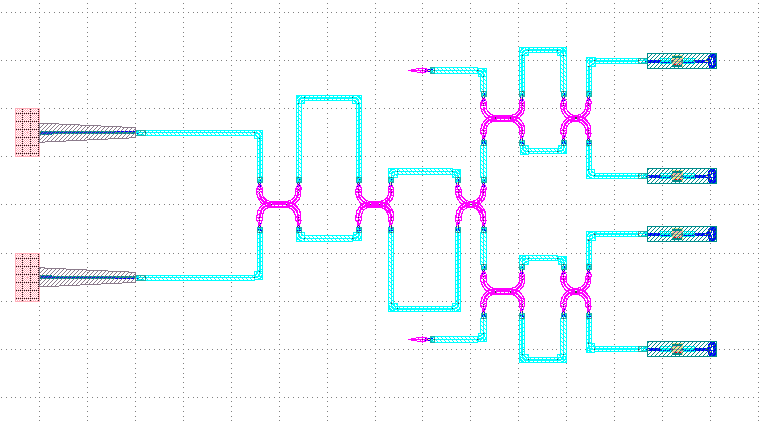
Instantiation of components
The GDS layout shows that there are 15 devices in total, but only 5 devices are instantiated in the program, indicating that some of the devices have the same parameters except for different locations, which are obtained by multiple calls.
ec = pdk.Fixed_Edge_Coupler(name="e") # Instantiate a Fixed_Edge_Coupler with default parameters and name it "ec"
# The following instantiates three DCs with different coupler_length, whose spacing, bend_radius, and waveguide_type are all the same
dc31 = pdk.DirectionalCouplerBend(
    coupler_spacing=1.5,
    coupler_length=31,
    bend_radius=25,
    waveguide_type=TECH.WG.MWG.C.WIRE,
)
dc18 = pdk.DirectionalCouplerBend(
    coupler_spacing=1.5,
    coupler_length=18,
    bend_radius=25,
    waveguide_type=TECH.WG.MWG.C.WIRE,
)
dc3 = pdk.DirectionalCouplerBend(
    coupler_spacing=1.5,
    coupler_length=3,
    bend_radius=25,
    waveguide_type=TECH.WG.MWG.C.WIRE,
)
# Instantiate a Fixed_Terminator_TE_1550 and rotate the angle by 180 degrees
tm = pdk.Fixed_Terminator_TE_1550(
    length=30,
    waveguide_type=TECH.WG.MWG.C.WIRE,
    transform=fp.rotate(degrees=180),
)
# Instantiate a Fixed_Photo_Detector with default parameters and name it "pd"
pd = pdk.Fixed_Photo_Detector(name="p")
Testing and Analysis
Based on the instantiated devices then generate ec_0 and ec_1, which are symmetric about the x-axis as their x-position is -100 and their y-position is 150 and -150.
ec_0 = ec.translated(-100, 150)
ec_1 = ec.translated(-100, -150)
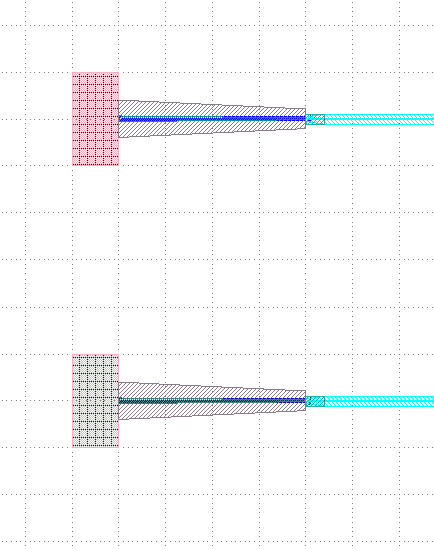
We try to change the y of both to -20,20 and see that they are close to each other and closer to the x-axis.
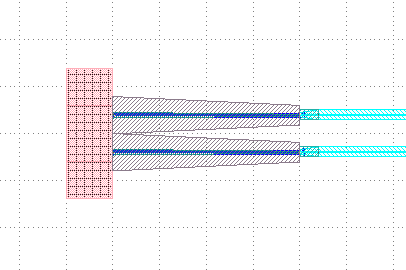
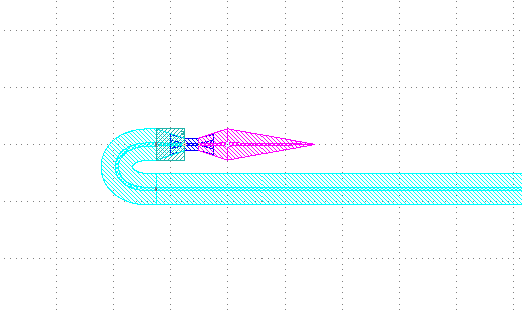
We change the rotation angle in tm to 0. We can see that the generated tm is oriented to the right, while the original 180 degrees is oriented to the left.
tm = pdk.Fixed_Terminator_TE_1550(
  length=30,
  waveguide_type=TECH.WG.MWG.C.WIRE,
  transform=fp.rotate(degrees=0)
The following code adjusts the horizontal and vertical coordinates of the generated new DC. The value of the x-direction shift is the value of the x-coordinate of op_3 of dc_2 minus the value of the x-coordinate of op_0 of dc31, .position[0] returns the x-coordinate, and .position[1] returns the corresponding y-coordinate.
dc_3_0 = dc31.translated(dc_2["op_3"].position[0] - dc31["op_0"].position[0], 180)
dc_3_1 = dc31.translated(dc_2["op_2"].position[0] - dc31["op_1"].position[0], -180)
Since there are more components and more ports are connected accordingly, automatic connection between ports can be achieved by using the create_links function.
links = fp.create_links(
          link_type=TECH.WG.SWG.C.WIRE,
          bend_factory=TECH.WG.SWG.C.WIRE.BEND_EULER,
          specs=[
              ec_0["op_0"] >> dc_0["op_0"],
              ec_1["op_0"] >> dc_0["op_1"],
              #
              (dc_0["op_3"] >> dc_1["op_0"], 500),
              dc_0["op_2"] >> dc_1["op_1"],
              dc_1["op_3"] >> dc_2["op_0"],
              (dc_1["op_2"] >> dc_2["op_1"], 500),
              #
              dc_2["op_3"] >> dc_3_0["op_1"],
              dc_2["op_2"] >> dc_3_1["op_0"],
              t_0["op_0"] >> dc_3_0["op_0"],
              t_1["op_0"] >> dc_3_1["op_1"],
              #
              (dc_3_0["op_3"] >> dc_4_0["op_0"], 300),
              dc_3_0["op_2"] >> dc_4_0["op_1"],
              dc_3_1["op_3"] >> dc_4_1["op_0"],
              (dc_3_1["op_2"] >> dc_4_1["op_1"], 300),
              #
              dc_4_0["op_3"] >> pd_0["op_0"],
              dc_4_0["op_2"] >> pd_1["op_0"],
              dc_4_1["op_3"] >> pd_2["op_0"],
              dc_4_1["op_2"] >> pd_3["op_0"],
          ],
      )
Get Pcells information via get
Note
To use get function, ensure you have upgraded your FnPcell version to 1.5.2rc5.
In the latest version of FnPcell, the information such as port positions, names, orientations, etc., can be collected by get function. Below scripts shows the usage of how to get the port positions of the Pcells which we initiate in Demultiplexer2:
pd_2 = device.get("pd_2", pdk.Fixed_Photo_Detector)
pd_2_op_0 = pd_2["op_0"]
print(pd_2_op_0.position)

(970.0, -60.0)
The first item in the bracket of get returns the key of the Pcell we initiate before, pd_2, which is a fixed photo detector been translated to (970, -60). The second item make sure that the type of the key is the one we are getting the information and is optional to insert.
It is also available to transform e.g. translated, rotated, mirrored the Pcell first then get the information.:
pd_3 = device.translated(20, 0).get("pd_3")
pd_3_op_0 = pd_3["op_0"]
print(pd_3_op_0.position)

(990.0, -300.0)
pd_3 is also a fixed photo detector which positioned at (970, -300) in the above script. By the get function, we first translated (20, 0) and get the position information of the port op_0.
Summary
Although there are more devices and Ports involved in demultiplexer devices, multiple devices can be easily generated and repositioned using fnpcell calls, and then they can be easily interconnected using the Linked function.