auto_transition.py
Create transition components
This function mainly defines the waveguide type and the default bend waveguide when the port is connected. Before this, users have to first create components such as FWG2MWGTransition to allow auto transition to work, and specified parameters such as transition length, shape will also be defined in the component (Ref: Lib/site-packages/gpdk/components/transition/fwg2mwg_transition.py).
Set up transition settings
We define several transition types which combines every possibilities between our waveguide types. The rules are set in class AUTO_TRANSITION, which we have to import it in gpdk/technology/tech.py after we defined it.
from typing import Tuple, cast
from fnpcell.pdk.technology import all as fpt
from .interfaces import CoreCladdingWaveguideType
from .wg import WG

def _c_fwg2mwg(end_types: Tuple[fpt.IWaveguideType, fpt.IWaveguideType]):
    from ..components.transition.fwg2mwg_transition import FWG2MWGTransition

    a = end_types[0]
    b = end_types[1]
    assert isinstance(a, WG.FWG.C)
    assert isinstance(b, WG.MWG.C)

    return FWG2MWGTransition(name="auto", length=20, fwg_type=a, mwg_type=b), ("op_0", "op_1")


def _c_fwg2swg(end_types: Tuple[fpt.IWaveguideType, fpt.IWaveguideType]):
    from ..components.transition.fwg2swg_transition import FWG2SWGTransition

    a = end_types[0]
    b = end_types[1]
    assert isinstance(a, WG.FWG.C)
    assert isinstance(b, WG.SWG.C)

    return FWG2SWGTransition(name="auto", length=20, fwg_type=a, swg_type=b), ("op_0", "op_1")


def _c_swg2mwg(end_types: Tuple[fpt.IWaveguideType, fpt.IWaveguideType]):
    from ..components.transition.swg2mwg_transition import SWG2MWGTransition

    a = end_types[0]
    b = end_types[1]
    assert isinstance(a, WG.SWG.C)
    assert isinstance(b, WG.MWG.C)

    return SWG2MWGTransition(name="auto", swg_length=10, mwg_length=10, swg_type=a, mwg_type=b), ("op_0", "op_1")


class _Taper:
    def __init__(self, slope: float) -> None:
        self.slope = slope

    def __call__(self, end_types: Tuple[fpt.IWaveguideType, fpt.IWaveguideType]):
        from ..components.taper.taper_linear import TaperLinear

        a = cast(CoreCladdingWaveguideType, end_types[0])
        b = cast(CoreCladdingWaveguideType, end_types[1])
        k = self.slope
        length = max(0.01, abs(a.core_width - b.core_width) / k)
        return TaperLinear(name="auto", length=length, left_type=a, right_type=b), ("op_0", "op_1")


class AUTO_TRANSITION:
    @fpt.classconst
    @classmethod
    def DEFAULT(cls):
        return fpt.AutoTransition().updated(
            [
                (WG.FWG.C >> WG.MWG.C, _c_fwg2mwg),
                (WG.FWG.C >> WG.SWG.C, _c_fwg2swg),
                (WG.SWG.C >> WG.MWG.C, _c_swg2mwg),
                #
                (WG.FWG.C >> WG.FWG.C, _Taper(0.2)),
                (WG.SWG.C >> WG.SWG.C, _Taper(0.2)),
                (WG.MWG.C >> WG.MWG.C, _Taper(0.2)),
            ]
        )
Example
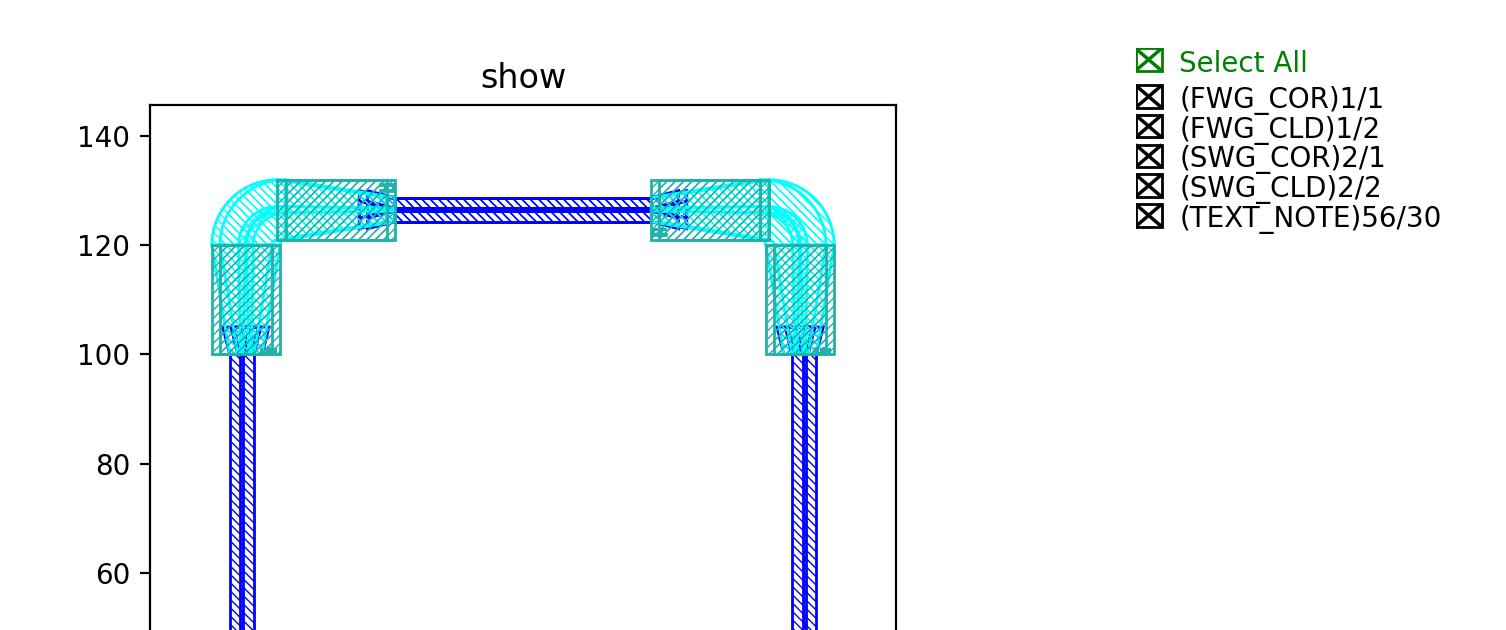
We use waveguide routing method create_links to demonstrate the auto transition function. You can see from the below figure, the link type of these waveguide ports is FWG.C.WIRE and the circular bend type is SWG.C.WIRE. Thus, _c_fwg2swg occurs in the transition between straight waveguide and circular bend:
link = fp.create_links(
    link_type=TECH.WG.FWG.C.WIRE,
    bend_factory=TECH.WG.SWG.C.WIRE.BEND_CIRCULAR,
    specs=[
        wg1["op_0"] >> wg2["op_1"],
        wg1["op_1"] >> wg3["op_1"],
    ],
)