extended
端口延长。
Extended类定义如下:
@dataclass(eq=False)
class Extended(PCell):
"""
Attributes:
device: device whose ports need to be extended
lengths: dict with port name as key, length as value, "*" means every other port
waveguide_type: type of generated waveguide
Examples:
```python
TECH = get_technology()
device = Extended(device=Mmi(waveguide_type=TECH.WG.FWG.C.WIRE), lengths={"*": 10, "op_0": 20, "op_1": 30})
fp.plot(device)
```

"""
device: fp.IDevice = fp.DeviceParam()
lengths: Mapping[str, float] = fp.MappingParam(K=str, V=Number, immutable=True)
waveguide_type: Optional[fp.IWaveguideType] = fp.WaveguideTypeParam(required=False)
def build(self) -> Tuple[fp.InstanceSet, fp.ElementSet, fp.PortSet]:
insts, elems, ports = super().build()
device = self.device
lengths = self.lengths
waveguide_type = self.waveguide_type
instance = device if waveguide_type is None else AutoTransitioned(device=device, waveguide_types={key: waveguide_type for key in lengths})
joints: List[Tuple[fp.IOwnedTerminal, fp.IOwnedTerminal]] = []
straight_ports: List[fp.IOwnedTerminal] = []
for port in instance.ports:
if isinstance(port, fp.IOwnedPort) and not port.disabled:
length = lengths.get(port.name) or lengths.get("*")
if length is not None:
if waveguide_type is not None:
length -= fp.distance_between(device[port.name].position, instance[port.name].position)
assert length > 0 or fp.is_zero(length), f"extend length of {port.name} is too short"
if length > 0:
s = Straight(length=length, waveguide_type=port.waveguide_type)
joints.append(port <= s["op_0"])
port_name = port.name
straight_ports.append(s["op_1"].with_name(fp.Hidden(port_name) if port.hidden else port_name))
used_port_names = set(port.name for port in straight_ports)
unused_ports = [port for port in instance.ports if port.name not in used_port_names]
connected = fp.Connected(
joints=joints,
ports=straight_ports + unused_ports,
)
insts += connected
ports += connected.ports
return insts, elems, ports
方法需要定义器件以及各端口延长的尺度,同时可以定义生成波导的类型:
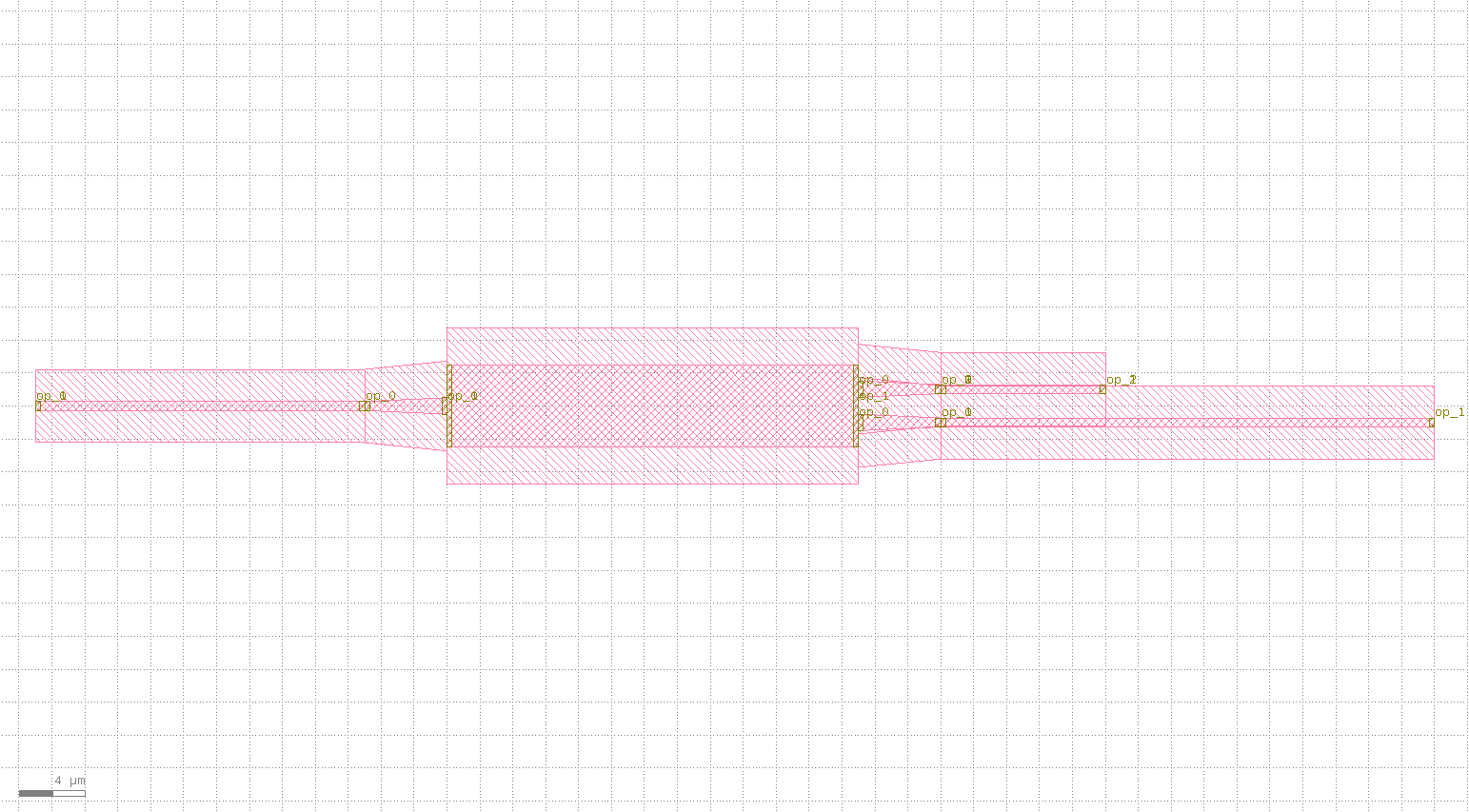
Extended(device=Mmi(waveguide_type=TECH.WG.FWG.C.WIRE), lengths={"*": 10, "op_0": 20, "op_1": 30})
最后生成版图文件:
gds_file = Path(__file__).parent / "local" / Path(__file__).with_suffix(".gds").name
library = fp.Library()
TECH = get_technology()
from gpdk.components.mmi.mmi import Mmi
library += Extended(device=Mmi(waveguide_type=TECH.WG.FWG.C.WIRE), lengths={"*": 10, "op_0": 20, "op_1": 30})
fp.export_gds(library, file=gds_file)
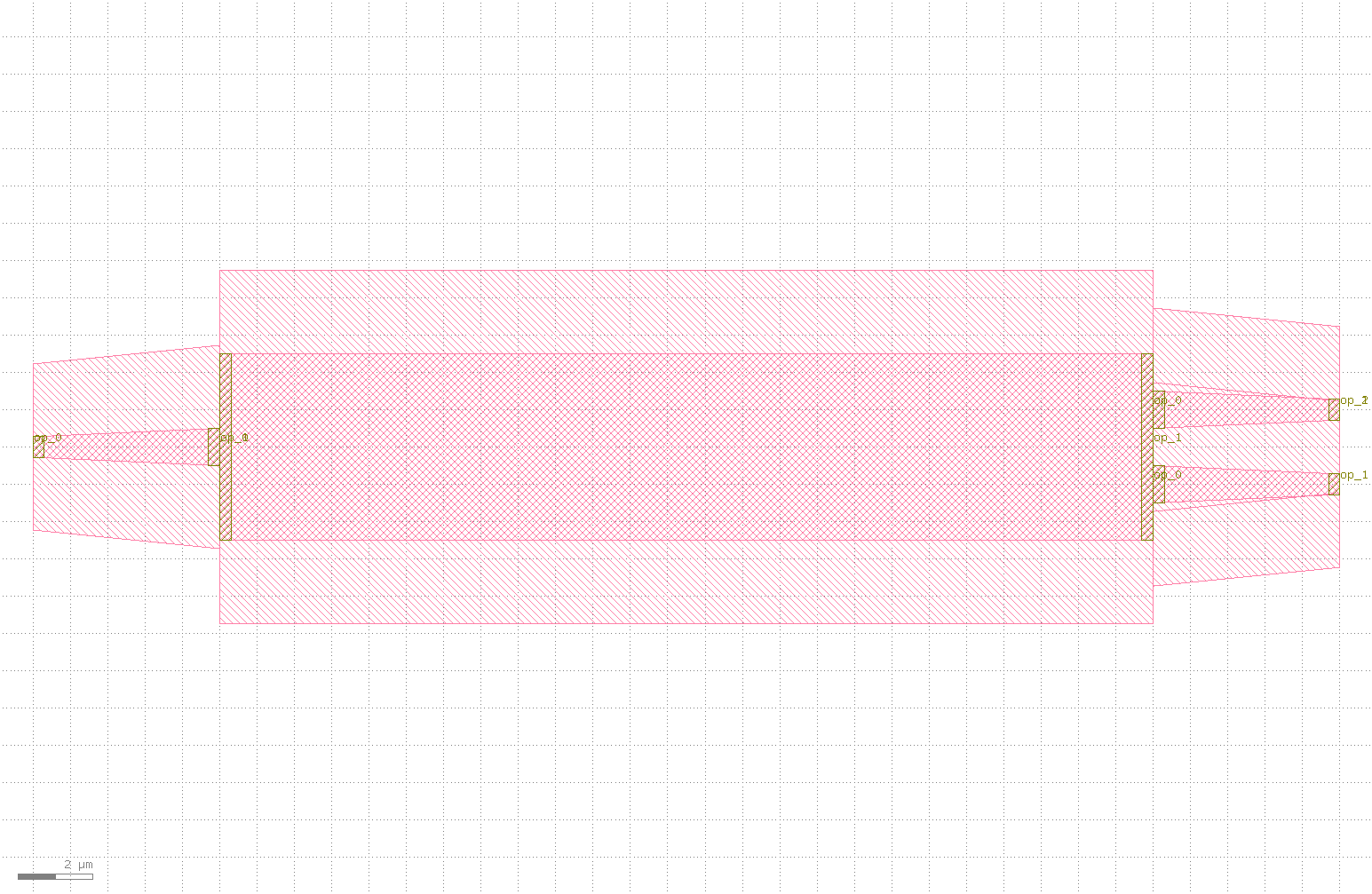
下面分别展示了MMI结构以及对应的经过端口延长后结构的版图,其中mmi结构的创建可以参见(mmi):