工具类api
工具类api主要包含:
translated
rotated
h_mirrored
v_mirrored
repositioned
position
get_bounding_box
下面将通过详细的代码解释各工具函数的功能以及用法。
translated
案例代码:
from dataclasses import dataclass
from functools import cached_property
from pathlib import Path
from typing import Tuple
from fnpcell import all as fp
from gpdk.technology import get_technology
@dataclass(eq=False)
class BendCircular(fp.IWaveguideLike, fp.PCell):
"""
Attributes:
degrees: central angle of the bend, in degrees
radius: raidus of the bend
waveguide_type: type of waveguide of the bend
port_names: defaults to ["op_0", "op_1"]
Examples:
```python
TECH = get_technology()
bend = BendCircular(name="s", radius=5, waveguide_type=TECH.WG.FWG.C.WIRE)
fp.plot(bend)
```

"""
degrees: float = fp.DegreeParam(default=90, min=-180, max=180, doc="Bend angle in degrees")
radius: float = fp.PositiveFloatParam(default=10, doc="Bend radius")
waveguide_type: fp.IWaveguideType = fp.WaveguideTypeParam(doc="Waveguide parameters")
port_names: fp.IPortOptions = fp.PortOptionsParam(count=2, default=["op_0", "op_1"])
def _default_waveguide_type(self):
return get_technology().WG.FWG.C.WIRE
def __post_pcell_init__(self):
assert fp.is_nonzero(self.degrees)
@cached_property
def raw_curve(self):
return fp.g.EllipticalArc(
radius=self.radius,
final_degrees=self.degrees,
)
def build(self) -> Tuple[fp.InstanceSet, fp.ElementSet, fp.PortSet]:
insts, elems, ports = super().build()
wg = self.waveguide_type(curve=self.raw_curve).with_ports(self.port_names)
insts += wg
ports += wg.ports
return insts, elems, ports
@dataclass(eq=False)
class BendCircular90(BendCircular):
degrees: float = fp.DegreeParam(default=90, locked=True)
waveguide_type: fp.IWaveguideType = fp.WaveguideTypeParam(locked=True)
@fp.cache()
def sim_model(self, env: fp.ISimEnv):
return fp.sim.ExternalFileModel(Path(f"{type(self).__name__}_radius={self.radius}").with_suffix(".dat"))
@dataclass(eq=False)
class BendCircular90_FWG_C_WIRE(BendCircular90, locked=True):
radius: float = fp.PositiveFloatParam(default=3.225, doc="Bend radius")
@fp.cache()
def sim_model(self, env: fp.ISimEnv):
return fp.sim.ExternalFileModel(Path("BendCircular90_radius=10").with_suffix(".dat"))
@dataclass(eq=False)
class BendCircular90_FWG_C_EXPANDED(BendCircular, locked=True):
radius: float = fp.PositiveFloatParam(default=3.4, doc="Bend radius")
waveguide_type: fp.IWaveguideType = fp.WaveguideTypeParam()
def _default_waveguide_type(self):
return get_technology().WG.FWG.C.EXPANDED
@fp.cache()
def sim_model(self, env: fp.ISimEnv):
file_path = Path("BendCircular90_radius=10").with_suffix(".dat")
return fp.sim.ExternalFileModel(file_path)
if __name__ == "__main__":
from gpdk.util.path import local_output_file
gds_file = local_output_file(__file__).with_suffix(".gds")
library = fp.Library()
TECH = get_technology()
# =======================================================================
# fmt: off
library += BendCircular(name="s", radius=15, waveguide_type=TECH.WG.FWG.C.WIRE)
library += BendCircular(name="d", radius=15, waveguide_type=TECH.WG.FWG.C.WIRE).translated(0, 15)
library += BendCircular(name="t", radius=15, waveguide_type=TECH.WG.FWG.C.WIRE).translated(15, 0)
# fmt: on
# =============================================================
# fp.export_gds(library, file=gds_file)
fp.plot(library)
功能说明:
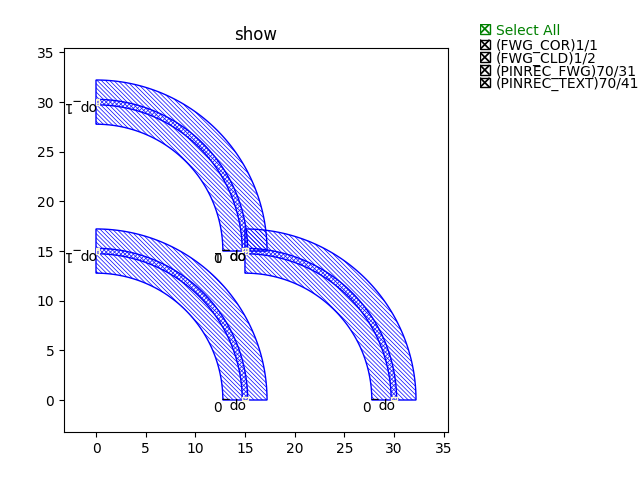
>>> library += BendCircular(name="d", radius=15, waveguide_type=TECH.WG.FWG.C.WIRE).translated(0, 15)
将组件向X轴正向平移15个基本单位
>>> library += BendCircular(name="t", radius=15, waveguide_type=TECH.WG.FWG.C.WIRE).translated(15, 0)
将组件向Y轴正向15个基本单位
案例展示:
rotated
案例代码:
import math
from dataclasses import dataclass
from fnpcell import all as fp
from gpdk.components.via.via import Via
from gpdk.technology import get_technology
@dataclass(eq=False)
class Vias(fp.PCell):
"""
Attributes:
width: width of array of via
height: height of array of via
spacing: spacing between vias in array
top_layer: defaults to `LAYER.MT_DRW`, top layer
via_layer: defaults to `LAYER.VIA2_DRW`, via layer
bottom_layer: defaults to `LAYER.M2_DRW`, bottom layer
port_names: defaults to ["ep_0", "ep_1"]
Examples:
```python
vias = Vias(name="s", width=4.3, height=4.3)
fp.plot(vias)
```

"""
width: float = fp.NonNegFloatParam(default=4.3)
height: float = fp.NonNegFloatParam(default=4.3)
spacing: float = fp.PositiveFloatParam()
top_layer: fp.ILayer = fp.LayerParam()
via_layer: fp.ILayer = fp.LayerParam()
bottom_layer: fp.ILayer = fp.LayerParam()
via: Via = fp.DeviceParam(type=Via)
port_names: fp.IPortOptions = fp.PortOptionsParam(count=2, default=["ep_0", "ep_1"])
def _default_spacing(self):
return get_technology().VIAS.SPACING
def _default_top_layer(self):
return get_technology().LAYER.MT_DRW
def _default_via_layer(self):
return get_technology().LAYER.VIA2_DRW
def _default_bottom_layer(self):
return get_technology().LAYER.M2_DRW
def _default_via(self):
return Via(
top_layer=self.top_layer,
via_layer=self.via_layer,
bottom_layer=self.bottom_layer,
port_names=(None, None),
)
def __post_pcell_init__(self):
assert self.spacing >= get_technology().VIAS.SPACING, f"requires spacing >= TECH.VIAS.SPACING, got: {self.spacing} >= {get_technology().VIAS.SPACING}"
def build(self):
insts, elems, ports = fp.InstanceSet(), fp.ElementSet(), fp.PortSet()
width = self.width
height = self.height
spacing = self.spacing
via = self.via
(x_min, y_min), (x_max, y_max) = fp.get_bounding_box(via)
w = x_max - x_min
h = y_max - y_min
width = max(width, w)
height = max(height, h)
m = max(1, math.floor((width + spacing) / (w + spacing)))
n = max(1, math.floor((height + spacing) / (h + spacing)))
col_width = width / m
row_height = height / n
spacing_x = (col_width - w) / 2
spacing_y = (row_height - h) / 2
via_array = via.new_array(
cols=m,
col_width=col_width,
rows=n,
row_height=row_height,
transform=fp.translate(-x_min - width / 2 + spacing_x, -y_min - height / 2 + spacing_y),
)
insts += via_array
# rect = fp.g.Rect(width=width, height=height, center=(0, 0))
# ports += fp.Pin(name=self.port_names[0], position=(0, 0), shape=rect, layer=self.top_layer)
# ports += fp.Pin(name=self.port_names[1], position=(0, 0), shape=rect, layer=self.bottom_layer)
return insts, elems, ports
if __name__ == "__main__":
from gpdk.util.path import local_output_file
gds_file = local_output_file(__file__).with_suffix(".gds")
library = fp.Library()
TECH = get_technology()
# =============================================================
# fmt: off
library += Vias()
library += Vias(name="s", width=4.3, height=4.3).rotated(degrees=10).translated(10,  0)
library += Vias(name="s", width=4.3, height=4.3).rotated(degrees=20).translated(20,  0)
library += Vias(name="s", width=4.3, height=4.3).rotated(degrees=30).translated(30,  0)
library += Vias(name="s", width=4.3, height=4.3).rotated(degrees=40).translated( 0, 10)
library += Vias(name="s", width=4.3, height=4.3).rotated(degrees=50).translated(10, 10)
library += Vias(name="s", width=4.3, height=4.3).rotated(degrees=60).translated(20, 10)
library += Vias(name="s", width=4.3, height=4.3).rotated(degrees=70).translated(30, 10)
library += Vias(name="s", width=4.3, height=4.3).rotated(degrees=80).translated(0, 20)
library += Vias(name="s", width=4.3, height=4.3).rotated(degrees=90).translated(10, 20)
library += Vias(name="s", width=4.3, height=4.3).rotated(degrees=100).translated(20, 20)
library += Vias(name="s", width=4.3, height=4.3).rotated(degrees=110).translated(30, 20)
library += Vias(name="s", width=4.3, height=4.3).rotated(degrees=120).translated(0, 30)
library += Vias(name="s", width=4.3, height=4.3).rotated(degrees=130).translated(10, 30)
library += Vias(name="s", width=4.3, height=4.3).rotated(degrees=140).translated(20, 30)
library += Vias(name="s", width=4.3, height=4.3).rotated(degrees=150).translated(30, 30)
library += Vias(name="s", width=4.3, height=4.3).rotated(degrees=160).translated(0, 40)
library += Vias(name="s", width=4.3, height=4.3).rotated(degrees=170).translated(10, 40)
library += Vias(name="s", width=4.3, height=4.3).rotated(degrees=180).translated(20, 40)
# fmt: on
# =============================================================
# fp.export_gds(library, file=gds_file)
fp.plot(library)
功能说明:
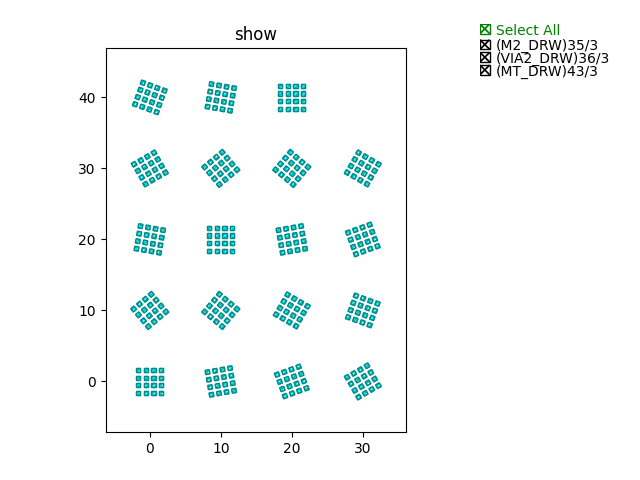
library += Vias(name="s", width=4.3, height=4.3).rotated(degrees=10).translated(10, 0)
library += Vias(name="s", width=4.3, height=4.3).rotated(degrees=20).translated(20, 0)
library += Vias(name="s", width=4.3, height=4.3).rotated(degrees=30).translated(30, 0)
library += Vias(name="s", width=4.3, height=4.3).rotated(degrees=40).translated( 0, 10)
library += Vias(name="s", width=4.3, height=4.3).rotated(degrees=50).translated(10, 10)
library += Vias(name="s", width=4.3, height=4.3).rotated(degrees=60).translated(20, 10)
library += Vias(name="s", width=4.3, height=4.3).rotated(degrees=70).translated(30, 10)
library += Vias(name="s", width=4.3, height=4.3).rotated(degrees=80).translated(0, 20)
library += Vias(name="s", width=4.3, height=4.3).rotated(degrees=90).translated(10, 20)
library += Vias(name="s", width=4.3, height=4.3).rotated(degrees=100).translated(20, 20)
library += Vias(name="s", width=4.3, height=4.3).rotated(degrees=110).translated(30, 20)
library += Vias(name="s", width=4.3, height=4.3).rotated(degrees=120).translated(0, 30)
library += Vias(name="s", width=4.3, height=4.3).rotated(degrees=130).translated(10, 30)
library += Vias(name="s", width=4.3, height=4.3).rotated(degrees=140).translated(20, 30)
library += Vias(name="s", width=4.3, height=4.3).rotated(degrees=150).translated(30, 30)
library += Vias(name="s", width=4.3, height=4.3).rotated(degrees=160).translated(0, 40)
library += Vias(name="s", width=4.3, height=4.3).rotated(degrees=170).translated(10, 40)
library += Vias(name="s", width=4.3, height=4.3).rotated(degrees=180).translated(20, 40)
组件逆时针依次旋转10度,并放置到相应位置。从左至右,从下至上。
案例展示:
h_mirrored
案例代码:
import math
from dataclasses import dataclass
from typing import Tuple, cast
from fnpcell import all as fp
from gpdk.components.sbend.sbend_circular import SBendCircular
from gpdk.components.straight.straight import Straight
from gpdk.technology import get_technology
from gpdk.technology.interfaces import CoreCladdingWaveguideType
@dataclass(eq=False)
class DirectionalCouplerSBend(fp.PCell):
"""
Attributes:
coupler_spacing: Spacing between the two waveguide centre lines.
coupler_length: Length of the directional coupler
bend_radius: Bend radius for the auto-generated bends
bend_degrees: Angle(in degrees) at which the directional coupler is bent
straight_after_bend: Length of the straight waveguide after the bend
waveguide_type: type of waveguide
port_names: defaults to ["op_0", "op_1", "op_2", "op_3"]
Examples:
```python
TECH = get_technology()
dc = DirectionalCouplerSBend(name="f", coupler_spacing=0.7, coupler_length=6, bend_radius=10, bend_degrees=30, straight_after_bend=6, waveguide_type=TECH.WG.FWG.C.WIRE)
fp.plot(dc)
```

"""
coupler_spacing: float = fp.PositiveFloatParam(default=0.7, doc="Spacing between the two waveguide centre lines.")
coupler_length: float = fp.PositiveFloatParam(default=6, doc="Length of the directional coupler")
bend_radius: float = fp.PositiveFloatParam(required=False, doc="Bend radius for the auto-generated bends")
bend_degrees: float = fp.DegreeParam(default=30, min=0, max=90, invalid=[0], doc="Angle(in degrees) at which the directional coupler is bent")
straight_after_bend: float = fp.PositiveFloatParam(default=6, doc="Length of the straight waveguide after the bend")
waveguide_type: CoreCladdingWaveguideType = fp.WaveguideTypeParam(type=CoreCladdingWaveguideType, doc="Waveguide parameters")
port_names: fp.IPortOptions = fp.PortOptionsParam(count=4, default=["op_0", "op_1", "op_2", "op_3"])
def _default_waveguide_type(self):
return get_technology().WG.FWG.C.WIRE
def build(self) -> Tuple[fp.InstanceSet, fp.ElementSet, fp.PortSet]:
insts, elems, ports = super().build()
coupler_spacing = self.coupler_spacing
coupler_length = self.coupler_length
bend_radius = self.bend_radius
bend_degrees = self.bend_degrees
straight_after_bend = self.straight_after_bend
waveguide_type = self.waveguide_type
port_names = self.port_names
if bend_radius is None:
bend_radius = cast(float, waveguide_type.BEND_CIRCULAR.radius_eff) # type: ignore
assert coupler_spacing > waveguide_type.core_width, "waveguide core overlap: coupler spacing must be greater than core_width"
central_angle = math.radians(bend_degrees)
d = bend_radius * math.sin(central_angle)
h = bend_radius - bend_radius * math.cos(central_angle)
sbend_height = h * 2
sbend_distance = d * 2
dy = coupler_spacing / 2
dx = coupler_length / 2
right_straight_after_bend = Straight(
name="afterbend",
length=straight_after_bend,
waveguide_type=waveguide_type,
transform=fp.translate(dx + sbend_distance, -dy - sbend_height),
)
left_straight_after_bend = right_straight_after_bend.h_mirrored()
sbend = SBendCircular(
name="sbend",
distance=sbend_distance,
height=sbend_height,
min_radius=bend_radius,
waveguide_type=waveguide_type,
transform=fp.translate(-d - dx, -h - dy),
)
straight_coupler = Straight(
name="coupler",
length=coupler_length,
waveguide_type=waveguide_type,
transform=fp.translate(-dx, -dy),
)
bottom_half = fp.Device(
name="bottom",
content=[
right_straight_after_bend,
sbend,
straight_coupler,
sbend.h_mirrored(),
left_straight_after_bend,
],
ports=[
left_straight_after_bend["op_1"].with_name("op_0"),
right_straight_after_bend["op_1"],
],
)
insts += bottom_half
# ports += bottom_half["op_0"].with_name(port_names[1]) # for right port index(0 1 2 3) in netlist
# ports += bottom_half["op_1"].with_name(port_names[2])
top_half = bottom_half.v_mirrored()
insts += top_half
ports += top_half["op_0"].with_name(port_names[0])
ports += bottom_half["op_0"].with_name(port_names[1])
ports += bottom_half["op_1"].with_name(port_names[2])
ports += top_half["op_1"].with_name(port_names[3])
return insts, elems, ports
if __name__ == "__main__":
from gpdk.util.path import local_output_file
gds_file = local_output_file(__file__).with_suffix(".gds")
library = fp.Library()
TECH = get_technology()
# =============================================================
# fmt: off
library += DirectionalCouplerSBend()
# library += DirectionalCouplerSBend(name="f", coupler_spacing=0.7, coupler_length=6, bend_radius=10, bend_degrees=30, straight_after_bend=6, waveguide_type=TECH.WG.FWG.C.WIRE)
# library += DirectionalCouplerSBend(name="s", coupler_spacing=1.7, coupler_length=6, bend_radius=20, bend_degrees=30, straight_after_bend=6, waveguide_type=TECH.WG.SWG.C.WIRE)
# fmt: on
# =============================================================
# fp.export_gds(library, file=gds_file)
fp.plot(library)
功能说明:
>>>left_straight_after_bend = right_straight_after_bend.h_mirrored()
水平镜像
v_mirrored
案例展示:
import math
from dataclasses import dataclass
from typing import Tuple, cast
from fnpcell import all as fp
from gpdk.components.sbend.sbend_circular import SBendCircular
from gpdk.components.straight.straight import Straight
from gpdk.technology import get_technology
from gpdk.technology.interfaces import CoreCladdingWaveguideType
@dataclass(eq=False)
class DirectionalCouplerSBend(fp.PCell):
"""
Attributes:
coupler_spacing: Spacing between the two waveguide centre lines.
coupler_length: Length of the directional coupler
bend_radius: Bend radius for the auto-generated bends
bend_degrees: Angle(in degrees) at which the directional coupler is bent
straight_after_bend: Length of the straight waveguide after the bend
waveguide_type: type of waveguide
port_names: defaults to ["op_0", "op_1", "op_2", "op_3"]
Examples:
```python
TECH = get_technology()
dc = DirectionalCouplerSBend(name="f", coupler_spacing=0.7, coupler_length=6, bend_radius=10, bend_degrees=30, straight_after_bend=6, waveguide_type=TECH.WG.FWG.C.WIRE)
fp.plot(dc)
```

"""
coupler_spacing: float = fp.PositiveFloatParam(default=0.7, doc="Spacing between the two waveguide centre lines.")
coupler_length: float = fp.PositiveFloatParam(default=6, doc="Length of the directional coupler")
bend_radius: float = fp.PositiveFloatParam(required=False, doc="Bend radius for the auto-generated bends")
bend_degrees: float = fp.DegreeParam(default=30, min=0, max=90, invalid=[0], doc="Angle(in degrees) at which the directional coupler is bent")
straight_after_bend: float = fp.PositiveFloatParam(default=6, doc="Length of the straight waveguide after the bend")
waveguide_type: CoreCladdingWaveguideType = fp.WaveguideTypeParam(type=CoreCladdingWaveguideType, doc="Waveguide parameters")
port_names: fp.IPortOptions = fp.PortOptionsParam(count=4, default=["op_0", "op_1", "op_2", "op_3"])
def _default_waveguide_type(self):
return get_technology().WG.FWG.C.WIRE
def build(self) -> Tuple[fp.InstanceSet, fp.ElementSet, fp.PortSet]:
insts, elems, ports = super().build()
coupler_spacing = self.coupler_spacing
coupler_length = self.coupler_length
bend_radius = self.bend_radius
bend_degrees = self.bend_degrees
straight_after_bend = self.straight_after_bend
waveguide_type = self.waveguide_type
port_names = self.port_names
if bend_radius is None:
bend_radius = cast(float, waveguide_type.BEND_CIRCULAR.radius_eff) # type: ignore
assert coupler_spacing > waveguide_type.core_width, "waveguide core overlap: coupler spacing must be greater than core_width"
central_angle = math.radians(bend_degrees)
d = bend_radius * math.sin(central_angle)
h = bend_radius - bend_radius * math.cos(central_angle)
sbend_height = h * 2
sbend_distance = d * 2
dy = coupler_spacing / 2
dx = coupler_length / 2
right_straight_after_bend = Straight(
name="afterbend",
length=straight_after_bend,
waveguide_type=waveguide_type,
transform=fp.translate(dx + sbend_distance, -dy - sbend_height),
)
left_straight_after_bend = right_straight_after_bend.h_mirrored()
sbend = SBendCircular(
name="sbend",
distance=sbend_distance,
height=sbend_height,
min_radius=bend_radius,
waveguide_type=waveguide_type,
transform=fp.translate(-d - dx, -h - dy),
)
straight_coupler = Straight(
name="coupler",
length=coupler_length,
waveguide_type=waveguide_type,
transform=fp.translate(-dx, -dy),
)
bottom_half = fp.Device(
name="bottom",
content=[
right_straight_after_bend,
sbend,
straight_coupler,
sbend.h_mirrored(),
left_straight_after_bend,
],
ports=[
left_straight_after_bend["op_1"].with_name("op_0"),
right_straight_after_bend["op_1"],
],
)
insts += bottom_half
# ports += bottom_half["op_0"].with_name(port_names[1]) # for right port index(0 1 2 3) in netlist
# ports += bottom_half["op_1"].with_name(port_names[2])
top_half = bottom_half.v_mirrored()
insts += top_half
ports += top_half["op_0"].with_name(port_names[0])
ports += bottom_half["op_0"].with_name(port_names[1])
ports += bottom_half["op_1"].with_name(port_names[2])
ports += top_half["op_1"].with_name(port_names[3])
return insts, elems, ports
if __name__ == "__main__":
from gpdk.util.path import local_output_file
gds_file = local_output_file(__file__).with_suffix(".gds")
library = fp.Library()
TECH = get_technology()
# =============================================================
# fmt: off
library += DirectionalCouplerSBend()
# library += DirectionalCouplerSBend(name="f", coupler_spacing=0.7, coupler_length=6, bend_radius=10, bend_degrees=30, straight_after_bend=6, waveguide_type=TECH.WG.FWG.C.WIRE)
# library += DirectionalCouplerSBend(name="s", coupler_spacing=1.7, coupler_length=6, bend_radius=20, bend_degrees=30, straight_after_bend=6, waveguide_type=TECH.WG.SWG.C.WIRE)
# fmt: on
# =============================================================
# fp.export_gds(library, file=gds_file)
fp.plot(library)
功能说明:
>>>top_half = bottom_half.v_mirrored()
垂直镜像
repositioned
案例代码:
from dataclasses import dataclass
from fnpcell import all as fp
from gpdk import all as pdk
from gpdk.technology import get_technology


@dataclass(eq=False)
class PortTransform(fp.PCell):
    def build(self):
        insts, elems, ports = super().build()
        # fmt: off
        TECH = get_technology()

        bend_bezier0 = pdk.BendBezier(start=(0, 0), controls=[(30, 30)], end=(60, 0), waveguide_type=TECH.WG.FWG.C.WIRE)
        insts += bend_bezier0

        bend_repositioned = bend_bezier0['op_1'].repositioned(at=bend_bezier0["op_0"]).owner
        insts += bend_repositioned

        # bend_bezier = bend_bezier0.translated(0, 100)
        # insts += bend_bezier
        # bend_rotated = bend_bezier['op_1'].rotated(degrees=60).owner
        # insts += bend_rotated
        #
        # bend_bezier = bend_bezier0.translated(100, 0)
        # insts += bend_bezier
        # bend_h = bend_bezier['op_1'].h_mirrored().owner
        # insts += bend_h
        #
        # bend_bezier = bend_bezier0.translated(100, 100)
        # insts += bend_bezier
        # bend_v = bend_bezier['op_1'].v_mirrored().owner
        # insts += bend_v
        #
        # bend_bezier = bend_bezier0.translated(0, 200)
        # insts += bend_bezier
        # bend_c = bend_bezier['op_1'].c_mirrored().owner
        # insts += bend_c

        # fmt: on
        return insts, elems, ports


if __name__ == "__main__":
    from gpdk.util.path import local_output_file

    gds_file = local_output_file(__file__).with_suffix(".gds")
    library = fp.Library()

    TECH = get_technology()
    # =============================================================
    # fmt: off

    library += PortTransform()

    # fmt: on
    # =============================================================
    # fp.export_gds(library, file=gds_file)
    fp.plot(library)
功能说明:
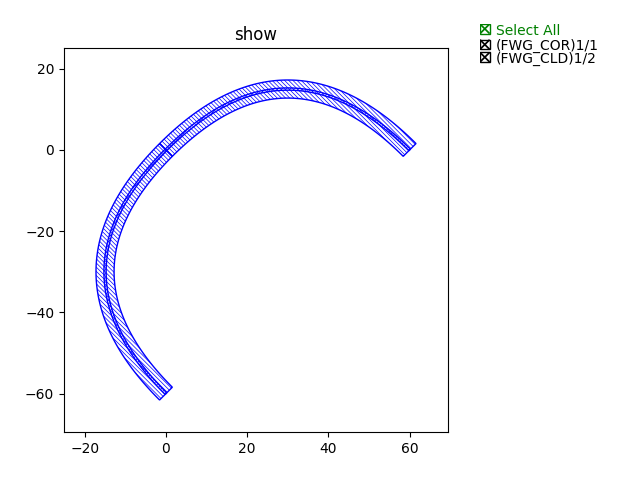
bend_repositioned = bend_bezier0['op_1'].repositioned(at=bend_bezier0["op_0"]).owner
insts += bend_repositioned
将新建器件端口’op_1’放置到原有器件”op_0”端口处
案例展示:
position
案例代码:
from dataclasses import dataclass
from fnpcell import all as fp
from gpdk import all as pdk
from gpdk.technology import WG, get_technology


@dataclass(eq=False)
class Circuit01(fp.PCell):
    gc_spacing: float = fp.FloatParam(default=90, min=0)
    ring_radius: float = fp.FloatParam(default=10, min=0)
    bend_degrees: float = fp.DegreeParam(default=30, min=-60, max=60, invalid=[0])
    swg_spacing: float = fp.FloatParam(default=30, min=0)
    swg_length: float = fp.FloatParam(default=10, min=0)
    fwg_type: WG.FWG.C = fp.WaveguideTypeParam(type=WG.FWG.C)
    swg_type: WG.SWG.C = fp.WaveguideTypeParam(type=WG.SWG.C)
    mwg_type: WG.MWG.C = fp.WaveguideTypeParam(type=WG.MWG.C)
    transform: fp.Affine2D = fp.TransformParam()
    dc_0: fp.IDevice = fp.DeviceParam(type=pdk.DirectionalCouplerSBend, port_count=4, required=False)
    dc_1: fp.IDevice = fp.DeviceParam(type=pdk.DirectionalCouplerSBend, port_count=4, required=False)
    gc_0: fp.IDevice = fp.DeviceParam(type=pdk.GratingCoupler, port_count=1, required=False)
    gc_1: fp.IDevice = fp.DeviceParam(type=pdk.GratingCoupler, port_count=1, required=False)
    gc_2: fp.IDevice = fp.DeviceParam(type=pdk.GratingCoupler, port_count=1, required=False)
    gc_3: fp.IDevice = fp.DeviceParam(type=pdk.GratingCoupler, port_count=1, required=False)

    def _default_fwg_type(self):
        return get_technology().WG.FWG.C.WIRE

    def _default_swg_type(self):
        return get_technology().WG.SWG.C.WIRE

    def _default_mwg_type(self):
        return get_technology().WG.MWG.C.WIRE

    def build(self):
        insts, elems, ports = super().build()
        gc_spacing = self.gc_spacing
        fwg_type = self.fwg_type
        swg_type = self.swg_type
        mwg_type = self.mwg_type
        bend_degrees = self.bend_degrees
        swg_spacing = self.swg_spacing
        swg_length = self.swg_length

        fwg_ring_filter = pdk.RingFilter(name="f0", ring_radius=self.ring_radius, waveguide_type=fwg_type)

        ring_port_spacing = fp.distance_between(fwg_ring_filter["op_0"].position, fwg_ring_filter["op_1"].position)

        dc_0_fanout = pdk.HFanout(
            name="dc_f0",
            device=(
                self.dc_0
                or pdk.DirectionalCouplerSBend(
                    name="0",
                    waveguide_type=fwg_type,
                )
            ),
            left_spacing=swg_spacing,
            right_spacing=ring_port_spacing,
            bend_degrees=bend_degrees,
            device_left_ports=["op_0", "op_1"],
            device_right_ports=["op_2", "op_3"],
        )

        dc_1_fanout = pdk.HFanout(
            name="dc_f1",
            device=(
                self.dc_1
                or pdk.DirectionalCouplerSBend(
                    name="1",
                    waveguide_type=fwg_type,
                )
            ),
            left_spacing=ring_port_spacing,
            device_left_ports=["op_0", "op_1"],
            right_spacing=swg_spacing,
            device_right_ports=["op_2", "op_3"],
            bend_degrees=bend_degrees,
        )

        short_transition_length = 5.0
        fwg2swg_0 = pdk.FWG2SWGTransition(name="0", fwg_type=fwg_type, swg_type=swg_type, length=short_transition_length)
        fwg2swg_1 = pdk.FWG2SWGTransition(name="1", fwg_type=fwg_type, swg_type=swg_type, length=short_transition_length)
        fwg2swg_3 = pdk.FWG2SWGTransition(name="3", fwg_type=fwg_type, swg_type=swg_type, length=short_transition_length)
        fwg2swg_2 = pdk.FWG2SWGTransition(name="2", fwg_type=fwg_type, swg_type=swg_type, length=short_transition_length)

        ring_connected = fp.Connected(
            name="Connected_1",
            joints=[
                fwg_ring_filter["op_0"] <= dc_0_fanout["op_3"],
                dc_0_fanout["op_0"] <= fwg2swg_0["op_0"],
                #
                fwg_ring_filter["op_1"] <= dc_0_fanout["op_2"],
                dc_0_fanout["op_1"] <= fwg2swg_1["op_0"],
                #
                fwg_ring_filter["op_3"] <= dc_1_fanout["op_0"],
                dc_1_fanout["op_3"] <= fwg2swg_3["op_0"],
                #
                fwg_ring_filter["op_2"] <= dc_1_fanout["op_1"],
                dc_1_fanout["op_2"] <= fwg2swg_2["op_0"],
            ],
            ports=[
                fwg2swg_0["op_1"].with_name("op_0"),
                fwg2swg_1["op_1"].with_name("op_1"),
                fwg2swg_2["op_1"].with_name("op_2"),
                fwg2swg_3["op_1"].with_name("op_3"),
            ],
        )

        s_0 = pdk.Straight(name="0", length=swg_length, waveguide_type=swg_type)
        s_1 = pdk.Straight(name="1", length=swg_length, waveguide_type=swg_type)
        s_2 = pdk.Straight(name="2", length=swg_length, waveguide_type=swg_type)
        s_3 = pdk.Straight(name="3", length=swg_length, waveguide_type=swg_type)

        swg2mwg_0 = pdk.SWG2MWGTransition(name="0", swg_type=swg_type, mwg_type=mwg_type)
        swg2mwg_1 = pdk.SWG2MWGTransition(name="1", swg_type=swg_type, mwg_type=mwg_type)
        swg2mwg_2 = pdk.SWG2MWGTransition(name="2", swg_type=swg_type, mwg_type=mwg_type)
        swg2mwg_3 = pdk.SWG2MWGTransition(name="3", swg_type=swg_type, mwg_type=mwg_type)

        ring_connected = fp.Connected(
            name="Connected_2",
            joints=[
                ring_connected["op_0"] <= s_0["op_1"],
                s_0["op_0"] <= swg2mwg_0["op_0"],
                #
                ring_connected["op_1"] <= s_1["op_1"],
                s_1["op_0"] <= swg2mwg_1["op_0"],
                #
                ring_connected["op_3"] <= s_3["op_0"],
                s_3["op_1"] <= swg2mwg_3["op_0"],
                #
                ring_connected["op_2"] <= s_2["op_0"],
                s_2["op_1"] <= swg2mwg_2["op_0"],
            ],
            ports=[
                swg2mwg_0["op_1"].with_name("op_0"),
                swg2mwg_1["op_1"].with_name("op_1"),
                swg2mwg_2["op_1"].with_name("op_2"),
                swg2mwg_3["op_1"].with_name("op_3"),
            ],
        )

        mwg_gc_0 = self.gc_0 or pdk.GratingCoupler(name="0", waveguide_type=mwg_type)
        mwg_gc_1 = self.gc_1 or pdk.GratingCoupler(name="1", waveguide_type=mwg_type)
        mwg_gc_2 = self.gc_2 or pdk.GratingCoupler(name="2", waveguide_type=mwg_type)
        mwg_gc_3 = self.gc_3 or pdk.GratingCoupler(name="3", waveguide_type=mwg_type)

        swg2mwg_spacing = fp.distance_between(ring_connected["op_0"].position, ring_connected["op_1"].position)

        left_sbend_pair = pdk.SBendCircularPair(left_spacing=gc_spacing, right_spacing=swg2mwg_spacing, bend_degrees=bend_degrees, waveguide_type=mwg_type)
        right_sbend_pair = pdk.SBendCircularPair(left_spacing=swg2mwg_spacing, right_spacing=gc_spacing, bend_degrees=bend_degrees, waveguide_type=mwg_type)

        ring_connected = fp.Connected(
            name="Connected_3",
            joints=[
                ring_connected["op_0"] <= left_sbend_pair["op_3"],
                left_sbend_pair["op_0"] <= mwg_gc_0["op_0"],
                #
                ring_connected["op_1"] <= left_sbend_pair["op_2"],
                left_sbend_pair["op_1"] <= mwg_gc_1["op_0"],
                #
                ring_connected["op_2"] <= right_sbend_pair["op_1"],
                right_sbend_pair["op_2"] <= mwg_gc_2["op_0"],
                #
                ring_connected["op_3"] <= right_sbend_pair["op_0"],
                right_sbend_pair["op_3"] <= mwg_gc_3["op_0"],
            ],
            ports=[],
        )
        insts += ring_connected
        return insts, elems, ports


if __name__ == "__main__":
    from gpdk.components import all as components
    from gpdk.util.path import local_output_file

    gds_file = local_output_file(__file__).with_suffix(".gds")
    library = fp.Library()

    TECH = get_technology()
    # =======================================================================
    # fmt: off

    fwg_type = TECH.WG.FWG.C.WIRE

    library += Circuit01(
        name="01",
        gc_spacing=100,
        ring_radius=50,
        swg_spacing=30,
        swg_length=50,
        fwg_type=fwg_type,
        swg_type=TECH.WG.SWG.C.WIRE,
        mwg_type=TECH.WG.MWG.C.WIRE,
        dc_0=pdk.DirectionalCouplerSBend(
            name="0",
            coupler_length=24,
            coupler_spacing=2.8,  # just for DEMO
            bend_radius=10,
            waveguide_type=fwg_type,
        ),
        # dc_1=pdk.Straight(name="t", length=100, waveguide_type=TECH.WG.FWG.C.WIRE),  # DeviceParam(type=...) DEMO
        gc_2=pdk.GratingCoupler(name="m2", length=50, waveguide_type=TECH.WG.MWG.C.WIRE),  # just for DEMO
    )

    # fmt: on
    # =============================================================
    fp.export_gds(library, file=gds_file)
    fp.export_spc(library, file=gds_file.with_suffix(".spc"), components=components)
    fp.export_pls(library, file=gds_file.with_suffix(".pls"), components=components)
功能说明:
(x, y) = fwg_ring_filter["op_0"].position
获取组件端口”op_0”的坐标信息。
get_bounding_box
案例代码:
import math
from dataclasses import dataclass
from typing import Tuple
from fnpcell import all as fp
from gpdk.components.bondpad.bondpad import BondPad
from gpdk.components.m_taper.m_taper import MTaper
from gpdk.technology import get_technology
@dataclass(eq=False)
class BondPadTapered(fp.PCell):
"""
Attributes:
pad_width: defaults to 75, width of the bondpad
pad_height: defaults to 75, height of the bondpad
taper_width: defaults to 20, width of the far-end of the taper part
taper_offset: defaults to 0, offset of the far-end, positive for left, negative for right. (base direction is from bondpad to taper)
taper_width: defaults to 20, length of the taper part
port_names: defaults to ["ep_0", "ep_1"]
Examples:
```python
bondpad = BondPadTapered(pad_width=75, pad_height=75)
fp.plot(bondpad)
```

"""
pad_width: float = fp.PositiveFloatParam(default=75)
pad_height: float = fp.PositiveFloatParam(default=75)
taper_width: float = fp.PositiveFloatParam(default=20)
taper_offset: float = fp.FloatParam(default=0)
taper_length: float = fp.PositiveFloatParam(default=20)
port_names: fp.IPortOptions = fp.PortOptionsParam(count=2, default=["ep_0", "ep_1"])
def build(self) -> Tuple[fp.InstanceSet, fp.ElementSet, fp.PortSet]:
insts, elems, ports = super().build()
TECH = get_technology()
# fmt: off
pad_width = self.pad_width
pad_height = self.pad_height
taper_width = self.taper_width
taper_length =self.taper_length
taper_offset = self.taper_offset
port_names = self.port_names
bond_pad = BondPad(pad_width=pad_width, pad_height=pad_height, port_names=[None, "ep_1"])
insts += bond_pad
(_, y_min), (_, _) = fp.get_bounding_box(bond_pad)
# m_taper = MTaper(initial_width=pad_width, final_width=taper_width, final_offset=taper_offset, length=taper_length, transform=fp.rotate(degrees=-90).translate(0, y_min))
# insts += m_taper
ports += fp.Pin(name=port_names[0], position=(0, y_min), orientation=-math.pi/2, shape=fp.g.Rect(width=0.1, height=0.1, center=(0, 0)).translated(0, y_min), metal_line_type=TECH.METAL.MT.W20) #layers=[TECH.LAYER.MT_DRW]
ports += bond_pad["ep_1"].with_name(port_names[1])
# fmt: on
return insts, elems, ports
if __name__ == "__main__":
from gpdk.util.path import local_output_file
gds_file = local_output_file(__file__).with_suffix(".gds")
library = fp.Library()
TECH = get_technology()
# =======================================================================
# fmt: off
library += BondPadTapered()
# library += BondPadTapered(pad_width=75, pad_height=75)
# library += BondPadTapered(pad_width=80, pad_height=60, transform=fp.translate(100, 0))
# library += BondPadTapered(pad_width=100, pad_height=100, transform=fp.translate(200, 0))
# fmt: on
# =============================================================
fp.export_gds(library, file=gds_file)
fp.plot(library)
功能说明:
>>>(x_min, y_min), (x_max, y_max) = fp.get_bounding_box(bond_pad)
>>>(x_min, y_min), (x_max, y_max) = fp.get_bounding_box(device, exclude_layers=[TECH.LAYER.PINREC_NOTE, TECH.LAYER.PINREC_TEXT])
获取组件的边界,参数“exclude_layers”是一个列表可以将不需要获取边界信息的层放进去,这样就可以获得理想层中结构的边界信息。