auto_transitioned
器件与器件连接时,很多时候我们会面临端口不匹配问题,此时需要引入taper波导实现过渡。自动端口转换函数为我们提供了端口转换的快速方法。
自动端口转换定义如下:
@dataclass(eq=False)
class AutoTransitioned(PCell):
"""
Attributes:
device: device whose ports need to be auto-transitioned
waveguide_type: dict with port name as key, waveguide type as value, "*" means every other port
Examples:
```python
TECH = get_technology()
device = AutoTransitioned(device=Mmi(waveguide_type=TECH.WG.FWG.C.WIRE), waveguide_types={"*": WG.SWG.C.WIRE})
fp.plot(device)
```

"""
device: fp.IDevice = fp.DeviceParam()
waveguide_types: Mapping[str, fp.IWaveguideType] = fp.MappingParam(K=str, V=fp.IWaveguideType, immutable=True)
def build(self) -> Tuple[fp.InstanceSet, fp.ElementSet, fp.PortSet]:
insts, elems, ports = super().build()
TECH = get_technology()
waveguide_types = self.waveguide_types
joints: List[Tuple[fp.IOwnedTerminal, fp.IOwnedTerminal]] = []
transition_ports: List[fp.IOwnedTerminal] = []
for port in self.device.ports:
if isinstance(port, fp.IOwnedPort) and not port.disabled:
start_type = port.waveguide_type
end_type = waveguide_types.get(port.name) or waveguide_types.get("*")
if end_type is not None and start_type != end_type:
transition, (port_in, port_out) = TECH.AUTO_TRANSITION.DEFAULT[start_type >> end_type]
joints.append(port <= transition[port_in])
port_name = port.name
transition_ports.append(transition[port_out].with_name(fp.Hidden(port_name) if port.hidden and port_name else port_name))
used_port_names = set(port.name for port in transition_ports)
unused_ports = [port for port in self.device.ports if not port.disabled and port.name not in used_port_names]
device = fp.Connected(
joints=joints,
ports=transition_ports + unused_ports,
)
insts += device
ports += device.ports
return insts, elems, ports
更多时候,我们了解如何使用即可:
library += AutoTransitioned(device=Mmi(waveguide_type=TECH.WG.FWG.C.WIRE), waveguide_types={"*": TECH.WG.SWG.C.WIRE})
fp.export_gds(library, file=gds_file)
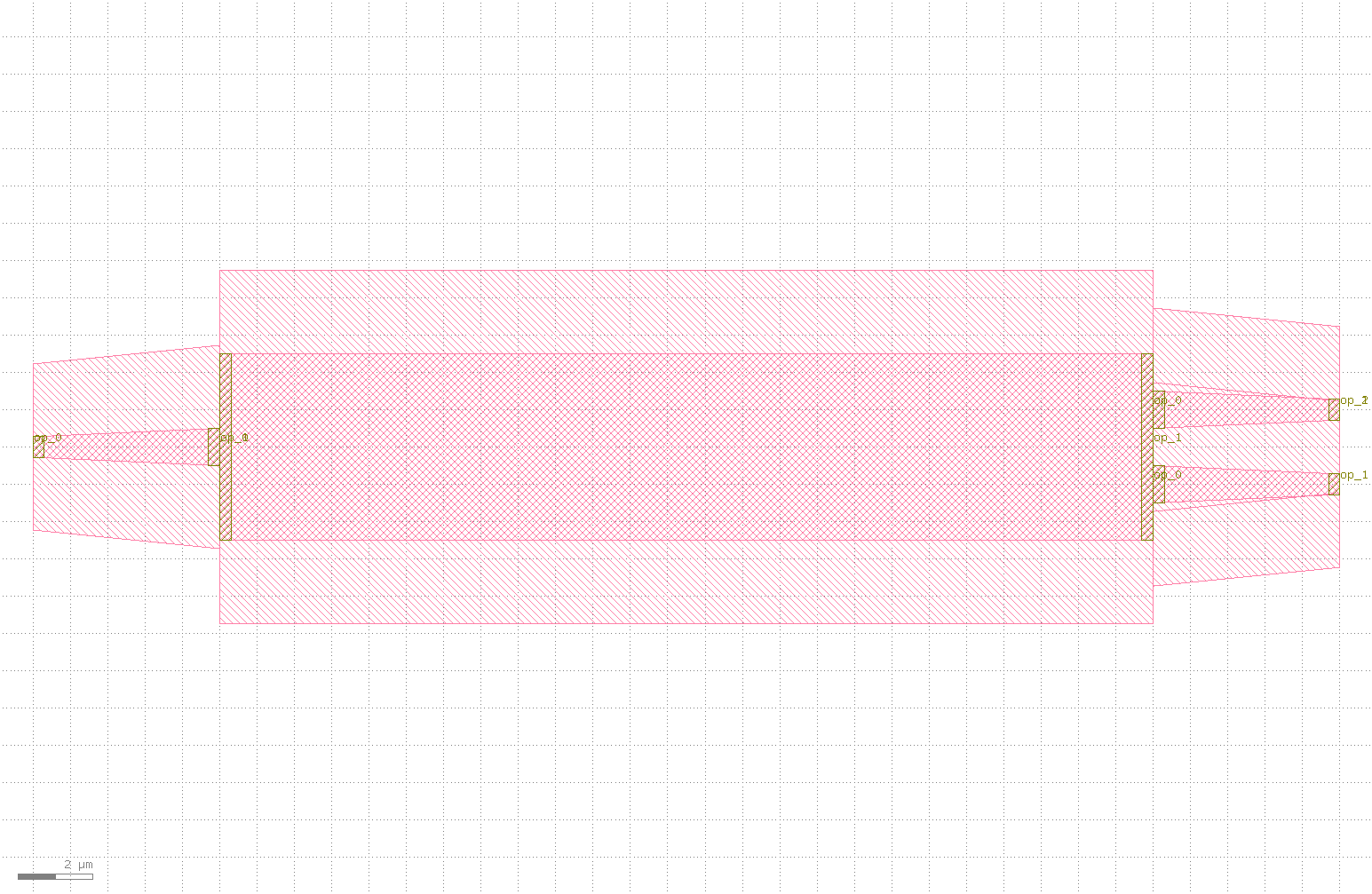
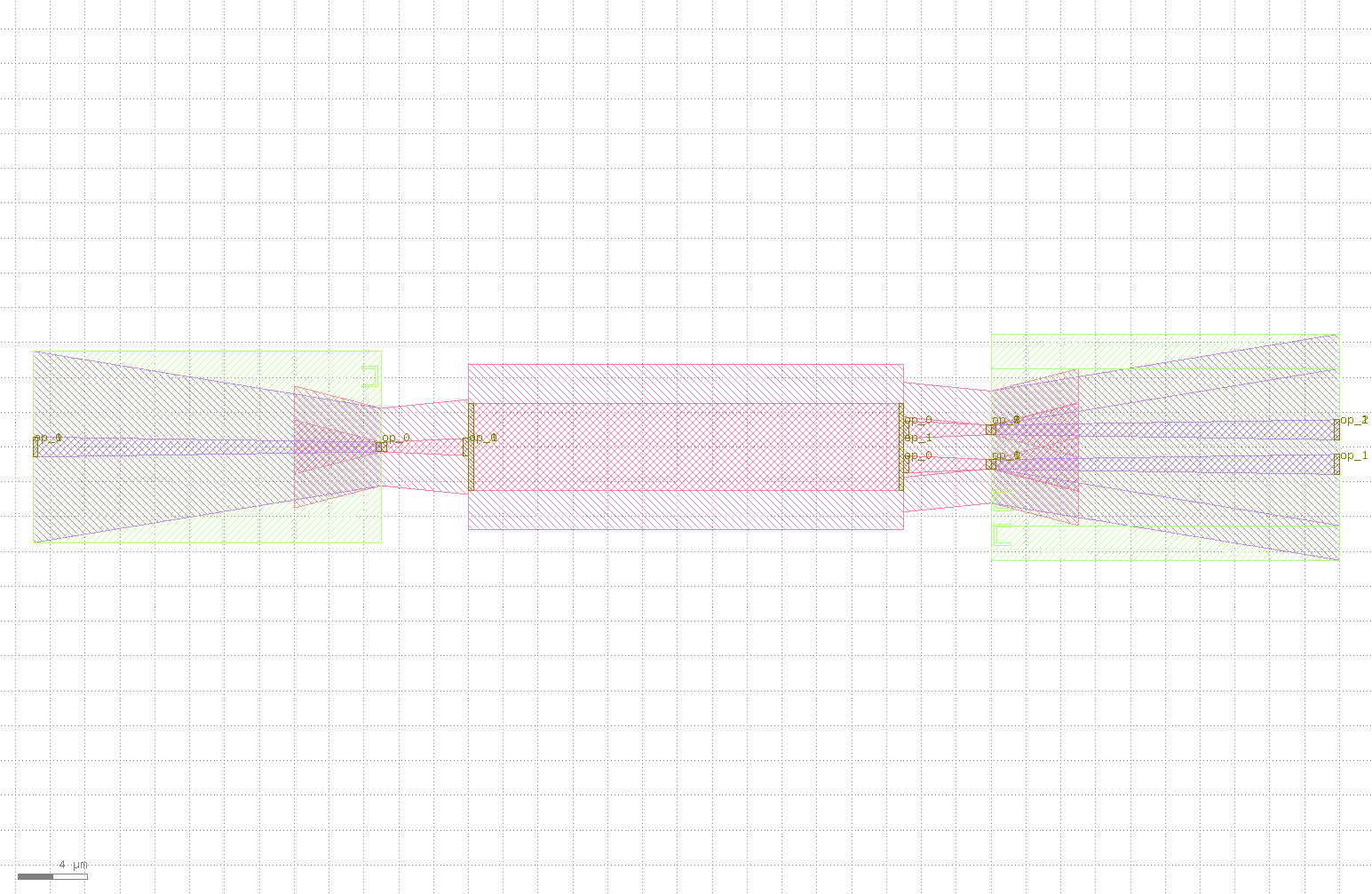
下面分别展示了MMI结构以及对应的经过自动端口转换后结构的版图,其中mmi结构的创建可以参见(mmi):